


Preserved Moss Walls vs Living Walls
The architect's complete guide to specification, performance, and ROI. Technical data, cost analysis, and certification pathways. No marketing fluff.
Table of contents
What are preserved moss walls?
Preserved moss walls are panels of natural moss that has been treated through a glycerin stabilisation process. The moss is harvested at peak maturity, then immersed in a plant-based glycerin solution that replaces the natural moisture content. The result: moss that maintains its natural colour, texture, and softness indefinitely, without any water, light, or maintenance.
The preservation process uses no toxic chemicals. The glycerin is food-grade, plant-derived, and biodegradable. Once preserved, the moss stops all biological activity. It does not grow, does not release spores, and does not decompose.
Types of preserved moss
Not all preserved moss is the same. Each type offers distinct textures, acoustic properties, and visual effects:
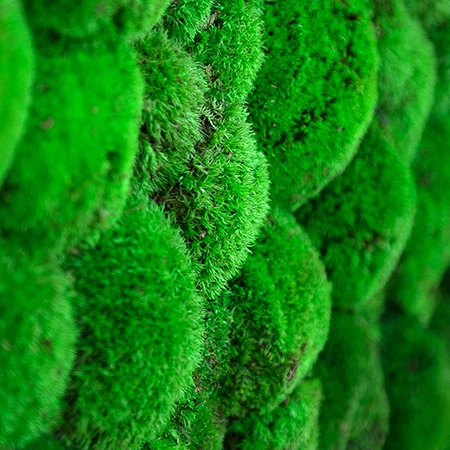
Round, pillow-like cushions with a rich, three-dimensional texture. The most effective acoustic absorber: NRC 0.73, tested to ISO 11654:1997. Fire rated B-S2-d0 (EN 13501-1). The premium choice for acoustic performance in commercial interiors.

Soft, spongy texture available in multiple colours (natural green, arctic white, deep green, custom dyed). Lightweight, versatile, and cost-effective. Ideal for large surface coverage, logos, and decorative panels.
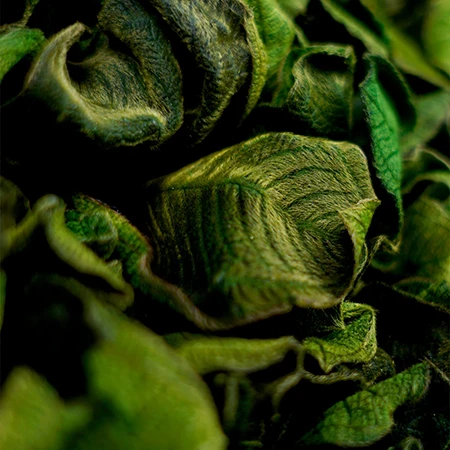
Flat, leaf-like texture that creates a lush, garden-like appearance. Dense coverage with a refined, layered aesthetic. Often used in hospitality and high-end residential projects.
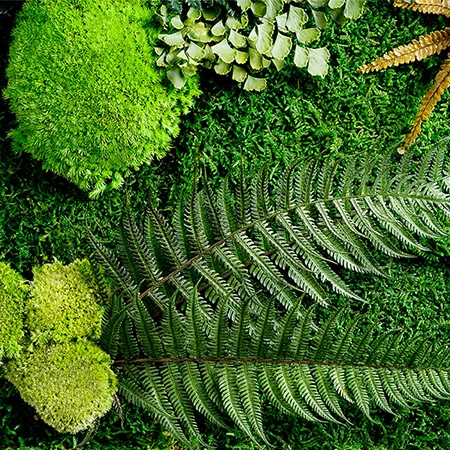
Natural, wild appearance combining multiple moss species and textures. Creates an organic, woodland effect. Used for installations that aim for a naturalistic rather than manicured look.

How long do preserved moss walls last?
With proper indoor installation (away from direct sunlight and excessive humidity), preserved moss walls maintain their appearance for 10 years or more without any intervention. Many installations remain unchanged after 15+ years.
The warranty period for professional-grade preserved moss panels is typically 10 years.
What are living green walls?
Living green walls (also called vertical gardens or green facades) are systems of live plants growing vertically on a wall structure. They require active infrastructure to sustain the plants: irrigation, drainage, growing medium, and often supplemental lighting.
Infrastructure requirements
A living wall is not a product. It is a system.
A typical installation requires:
- Irrigation system: Automated watering with timers, pumps, and distribution lines. Must be connected to building water supply and drainage.
- Growing medium: Soil, felt, or hydroponic substrate to support plant roots.
- Drainage: To prevent water damage to the wall behind the installation.
- Supplemental lighting: Many indoor installations require grow lights, especially in spaces without direct natural light.
- Structural support: Living walls when saturated weigh 30-80 kg/m², requiring structural assessment and potentially reinforcement.
The hidden costs of living walls
The purchase price of a living wall is only the beginning. The true cost includes ongoing plant maintenance (professional horticulturist visits for pruning, feeding, pest control, and plant replacement), plant replacement (10-20% annual mortality), water consumption, energy for grow lights, system failures (pump failures, clogged irrigation lines, sensor malfunctions), and downtime risk.
Head-to-head comparison
Maintenance
| Aspect | Preserved Moss Wall | Living Wall |
|---|---|---|
| Watering | None | Daily (automated) |
| Pruning | None | Monthly |
| Feeding / Fertilising | None | Monthly |
| Pest control | None | As needed |
| Plant replacement | None | 10-20% annually |
| Professional visits | None | Monthly or bi-monthly |
| Dusting | Occasional (compressed air) | Not applicable |
| Total annual hours | 0 | 40-80+ hours |
Installation complexity and weight
| Factor | Preserved Moss Wall | Living Wall |
|---|---|---|
| Weight per m² | 3-5 kg | 30-80 kg (saturated) |
| Structural assessment | No | Yes |
| Water connection | No | Yes |
| Drainage required | No | Yes |
| Electrical connection | No | Often (grow lights, pumps) |
| Installation time (20m²) | 1 day | 3-5 days |
| Disruption to occupied space | Minimal | Significant |

10-year total cost of ownership
This is where the real difference becomes clear
The table below compares a typical 20m² installation over a 10-year period.
| Cost Category | Preserved Moss Wall | Living Wall |
|---|---|---|
| Product and installation | €3,000 - 6,000 | €8,000 - 16,000 |
| Irrigation system | €0 | €2,000 - 5,000 |
| Structural reinforcement | €0 | €0 - 3,000 |
| Grow lights (if needed) | €0 | €1,000 - 3,000 |
| Annual maintenance (×10) | €0 | €10,000 - 20,000 |
| Plant replacement (×10) | €0 | €4,000 - 8,000 |
| Water costs (×10) | €0 | €2,000 - 5,000 |
| Energy / grow lights (×10) | €0 | €3,000 - 6,000 |
| 10-Year Total (20m²) | €3,000 - 6,000 | €30,000 - 66,000 |
All figures in EUR. Costs vary by region, specification, and complexity.
Over 10 years, a living wall costs 5-11x more than an equivalent preserved moss wall installation. The gap widens further when factoring in the risk of system failure and unplanned replacement.
Acoustic performance
The most overlooked comparison
Preserved moss walls deliver measurable, certified acoustic absorption. Living walls do not.
| Metric | Preserved Moss (Ball Moss) | Living Wall |
|---|---|---|
| NRC (Noise Reduction Coefficient) | 0.73 | Not tested / Not rated |
| Testing standard | ISO 11654:1997 | N/A |
| Mid-frequency absorption (500-2000 Hz) | Excellent | Variable, unverified |
| Acoustic certification available | Yes | No |
An NRC of 0.73 means Ball Moss absorbs 73% of sound energy hitting its surface. This is comparable to professional acoustic panels, but with the visual benefit of natural biophilic texture.
For comparison: standard acoustic ceiling tile rates NRC 0.55-0.70. Bare drywall rates approximately NRC 0.05.
No living wall manufacturer publishes NRC data tested to ISO standards. Acoustic claims for living walls are typically anecdotal or based on general vegetation studies, not product-specific lab testing.
Fire safety ratings
Non-negotiable for commercial interiors
| Standard | Preserved Moss (Ball Moss) | Living Wall |
|---|---|---|
| European (EN 13501-1) | B-S2-d0 | Not classified |
| US (ASTM E84) | FSI 0, SDI 15 | Not classified |
| Fire behaviour | Self-extinguishing | Variable (dependent on moisture) |
| Fire documentation | Yes, lab-tested | No standard documentation |
Air quality and humidity
The one area where living walls have a genuine advantage
Living plants actively photosynthesise, absorbing CO&sub2; and releasing oxygen. Some species also filter volatile organic compounds (VOCs) from indoor air. Living walls contribute to indoor humidity through transpiration.
Preserved moss does not photosynthesise. It is biologically inert after preservation. However, it also does not release allergens, pollen, or mould spores. It does not attract insects. And it does not affect indoor humidity levels, which can be an advantage in climate-controlled buildings.
| Factor | Preserved Moss Wall | Living Wall |
|---|---|---|
| CO&sub2; absorption | No | Yes |
| Oxygen release | No | Yes |
| VOC filtration | No | Some species, limited |
| Allergen release | None | Possible (pollen, mould) |
| Insect attraction | None | Possible |
| Humidity impact | None | Increases humidity |
| Mould risk | None | Present if poorly maintained |

Design flexibility and customisation
Preserved moss walls can be shaped into any form (curves, circles, logos, letters), combined with materials (oak frames, metal, cork), installed on walls, ceilings, and suspended structures, created in modular panels, and designed as architectural products (acoustic panels, room dividers, lighting fixtures).
Living walls can be designed with diverse plant species and colours, changed seasonally, designed with edible plants, and combined with water features.
Building certifications: WELL v2 & LEED v5
How preserved moss walls support certified green building projects
WELL v2 credits
Preserved moss walls directly satisfy the requirement for “nature incorporation in interior design.” No distinction is made between living and preserved biophilic elements.
Ball Moss walls with NRC 0.73 contribute measurably to reverberation time targets. Lab-tested acoustic data (ISO 11654) provides the documentation needed for credit submission.
LEED v5 credits
Biophilic design elements contribute to occupant wellbeing scores. Preserved moss walls qualify as biophilic elements under the “nature in the space” pattern.
Preserved moss walls are free of VOC emissions, contain no formaldehyde, and release no particulates. They contribute positively to indoor environmental quality.
How to specify for certified projects
When including preserved moss walls in WELL or LEED project submissions:
- Request the manufacturer's acoustic test report (ISO 11654 / ASTM C423)
- Request fire test certification (EN 13501-1 / ASTM E84)
- Request VOC emission test data or declaration of compliance
- Document the installation area (m²) relative to total wall area for biophilia credit calculations
- Include product technical data sheets in the project specification package
When to choose preserved moss walls
Commercial offices and corporate headquarters
The most common application. Preserved moss walls deliver acoustic performance, biophilic presence, and design sophistication with zero ongoing maintenance cost. For facility managers, the total absence of maintenance is decisive. For architects, the acoustic data and fire certification enable confident specification.
Hospitality and retail
Hotels, restaurants, and retail spaces benefit from the visual impact and texture of preserved moss without the liability of plant maintenance in high-traffic environments. Preserved moss withstands temperature fluctuations, dry air, and irregular lighting conditions typical of hospitality spaces.
Healthcare and education
Hygiene-sensitive environments where allergen control is critical. Preserved moss releases no pollen, harbours no mould, and requires no soil that could attract pests. The acoustic properties are particularly valuable in healthcare settings where noise reduction improves patient outcomes and staff wellbeing.

When living walls make sense
We believe in honest advice, even when it does not favour our products. Living walls are the right choice in specific situations:
Preserved moss is designed for indoor use. Living walls perform well outdoors where rainfall provides natural irrigation.
If a building already has irrigation systems in place, the infrastructure cost advantage of preserved moss is reduced.
If the brief specifically prioritises measurable air purification (CO&sub2; reduction, VOC removal), and acoustic performance and maintenance costs are secondary, living walls provide active biological air filtration.
Real projects: preserved moss walls in practice

L'Oreal Paris Headquarters
When L'Oreal needed biophilic design for their Paris headquarters, they specified preserved Ball Moss for meeting rooms and circulation areas. The decision factors: zero maintenance (critical for a corporate headquarters with no on-site horticultural team), NRC 0.73 acoustic performance for open-plan noise reduction, and consistent appearance year-round. Three years after installation, the moss walls are visually identical to day one.

JLL Brussels HQ (by Tetris Design and Build)
JLL's Brussels headquarters specified Greenmood Cork Tiles and preserved moss for meeting rooms, phone booths, and collaborative spaces. The acoustic data (NRC ratings and fire certification) enabled Tetris Design and Build to include the specification in the project's WELL building documentation. Every meeting room achieved target RT60 reverberation times.
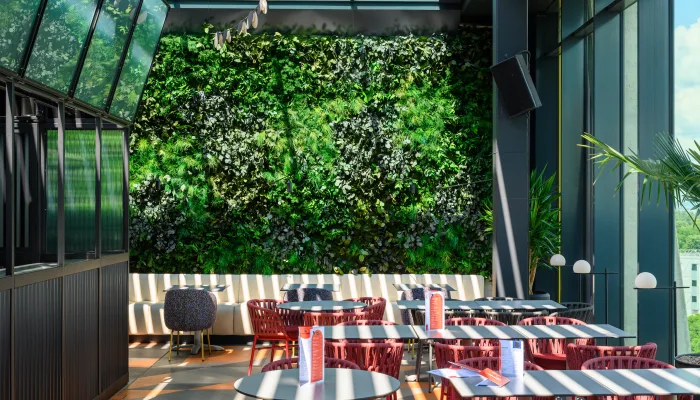
Cloud IX Budapest
A flexible coworking space across 4,000m² featuring preserved moss installations throughout. The design combined Ball Moss panels with natural oak framing and Greenmood's Design Collection products (Cascade, G-Circle). Zero maintenance was essential for a multi-tenant building where maintenance responsibility is shared.
Frequently asked questions
Do preserved moss walls purify the air?
No. Preserved moss is biologically inert after the glycerin stabilisation process. It does not photosynthesise, absorb CO&sub2;, or filter VOCs. However, it also releases no allergens, no pollen, no mould spores, and no VOC emissions. It is neutral from an air quality perspective.
Are preserved moss walls safe in case of fire?
Yes. Professional-grade preserved moss walls are fire tested and certified. Greenmood Ball Moss carries a B-S2-d0 rating under EN 13501-1 (European standard) and FSI 0 / SDI 15 under ASTM E84 (US standard). This means limited fire contribution, limited smoke, and no flaming droplets. The moss is self-extinguishing.
Can preserved moss walls be installed on ceilings?
Yes. Preserved moss is lightweight (3-5 kg/m²) and can be installed on ceilings, suspended structures, and overhead panels without structural reinforcement. Products like Cascade and Hoverlight are specifically designed for ceiling installation, combining preserved moss with integrated lighting and acoustic absorption.
How do I specify preserved moss walls for a WELL or LEED project?
Request the following documentation from the manufacturer: acoustic test report (ISO 11654 or ASTM C423), fire test certificate (EN 13501-1 or ASTM E84), and VOC emission data. Document the installation area relative to total wall/ceiling area. Include in the biophilia strategy (WELL Feature 88) and acoustic treatment plan (WELL Feature 78).
What is the NRC rating of preserved moss walls?
Ball Moss achieves NRC 0.73 when tested to ISO 11654:1997. This means it absorbs 73% of sound energy. For comparison, a standard acoustic ceiling tile typically rates NRC 0.55-0.70, and bare drywall rates approximately NRC 0.05.
How much do preserved moss walls cost compared to living walls?
Installation costs for preserved moss walls typically range from €150-300/m², depending on moss type and design complexity. Living walls cost €400-800/m² for installation alone, plus ongoing maintenance of €50-100/m² per year. Over 10 years, a preserved moss wall costs 5-11x less than an equivalent living wall installation.
Specification resources
- Ball Moss Acoustic Panels — Product specification and NRC data
- Cork Tiles by Alain Gilles — Product specification
- Design Collection Catalogue — Full range
- Fire Safety and Biophilic Materials — EN 13501-1 and ASTM E84 data
- Acoustic & Material Performance — ISO 11654 test data
- How to Specify Biophilic Acoustic Solutions — 5-step specification framework
- Sustainability & LEED v5 — Certification pathways
For project-specific technical assistance, contact your regional Greenmood representative or email pl@greenmood.pl